Table of Contents
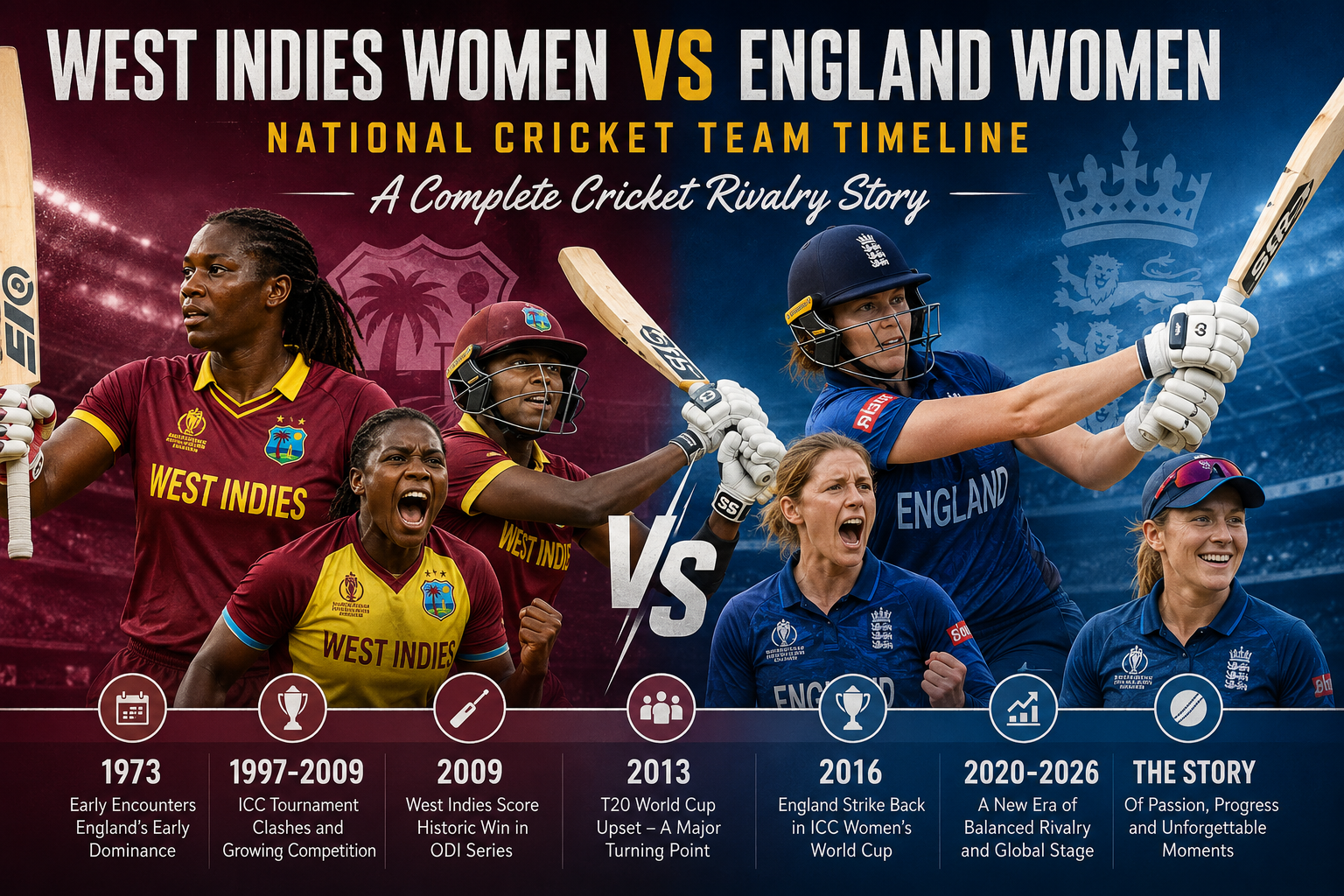
The West Indies Women Vs England Women’s National Cricket Team Timeline reflects one of the most intriguing cross-era rivalries in women’s cricket. From England’s early dominance in the 1970s and 80s to West Indies’ explosive rise in the modern T20 era, this matchup has evolved dramatically. What began as one-sided encounters has gradually transformed into a competitive and emotionally charged contest. In this timeline-based analysis, we explore how key matches, legendary performances, and shifting cricketing philosophies shaped this rivalry into a global spectacle watched by millions.
Early Foundations (1973–1993)
The earliest phase of the West Indies Women Vs England Women’s National Cricket Team Timeline was defined by England’s structured cricketing system versus the West Indies’ developing international setup. England entered women’s ODI cricket with strong domestic depth, while West Indies were still building consistency.
During the 1970s World Cup cycles, England often controlled matches through disciplined bowling and technical batting. West Indies, however, showed early signs of flair through aggressive stroke play, though inconsistency hurt them. This era was less about rivalry and more about learning curves, but it laid the foundation for future competitiveness.
By the late 1980s, West Indies began narrowing the gap. Their improved fitness and exposure to international tours allowed them to challenge England more meaningfully. Still, England held the upper hand due to superior experience and tactical awareness.
Early Era Match Snapshot Table
| Year | Format | Winner | Margin | Key Insight |
| 1973 | ODI | England Women | Dominant win | Experience gap visible |
| 1982 | ODI | England Women | Comfortable | Bowling control decisive |
| 1988 | ODI | England Women | Moderate win | WI improving batting |
| 1993 | ODI | England Women | Tight finish | Competitive shift begins |
Analysis:
These early encounters highlight England’s dominance but also West Indies’ gradual rise. The narrowing margins by the early 1990s are crucial because they signal the beginning of a more balanced rivalry that would fully evolve decades later.
ICC Tournament Clashes in the Timeline (1997–2009)
As women’s cricket became more structured under ICC governance, the West Indies Women Vs England Women’s National Cricket Team Timeline gained importance in global tournaments. ICC events brought pressure, visibility, and higher stakes.
England’s World Cup experience gave them a tactical advantage in group-stage encounters. Their batters were more technically sound in longer formats, while West Indies struggled with consistency under pressure. However, West Indies began producing standout players who could shift momentum in short bursts.
The 2000s marked a transition phase. West Indies started investing in grassroots cricket, which slowly translated into improved performances at ICC events. England still won most encounters, but the margin of dominance was shrinking.
ICC Tournament Performance Table
| Tournament | Matches Played | England Wins | WI Wins | Key Trend |
| 1997 WC | 2 | 2 | 0 | England control |
| 2000 WC | 1 | 1 | 0 | Tactical gap |
| 2005 WC | 2 | 2 | 0 | WI improving resistance |
| 2009 WC | 2 | 1 | 1 | Competitive balance emerging |
Analysis:
The most significant takeaway is the 2009 shift, where West Indies finally registered a breakthrough win. This changed psychological dynamics and marked the beginning of genuine rivalry rather than predictable outcomes.
Batting Legends
Batting performances have shaped much of the West Indies Women Vs England Women’s National Cricket Team Timeline. England’s traditional strength lay in technical consistency, while West Indies relied on power hitters capable of changing games quickly.
Players like Charlotte Edwards defined England’s dominance era with controlled innings, while West Indies stars such as Stafanie Taylor brought stability and elegance to their batting lineup. Taylor’s ability to anchor innings became crucial in narrowing the competitive gap.
In T20 cricket, West Indies batting philosophy shifted dramatically. Instead of rebuilding innings slowly, they embraced aggressive starts, particularly through explosive top-order hitters. England adapted by strengthening their middle-order resilience.
Batting Impact Comparison Table
| Player Type | England Strength | West Indies Strength | Match Impact |
| Openers | Technical stability | Aggressive starts | Powerplay control |
| Middle order | Anchoring innings | Fast acceleration | Momentum shifts |
| Finishers | Controlled finishes | High-risk hitting | Late overs dominance |
Analysis:
This comparison shows how contrasting batting philosophies shaped the rivalry. England focused on structure, while West Indies leaned on instinct and aggression, especially in T20 formats.
Bowling Battles and Tactical Evolution in the Timeline
Bowling has been a decisive factor in the West Indies Women Vs England Women’s National Cricket Team Timeline. England historically relied on disciplined seam and swing bowling, particularly effective in home conditions. Their bowlers focused on line-and-length precision.
West Indies, on the other hand, developed strong spin options and later introduced pace variations in T20 cricket. Their ability to adapt to different conditions improved significantly after 2010.
A major shift occurred when West Indies began using slower balls and cutters more effectively in white-ball formats. England responded by strengthening death-over bowling strategies.
Bowling Comparison Table
| Aspect | England Women | West Indies Women | Impact Area |
| Seam Bowling | Highly structured | Developing phase | Early overs control |
| Spin Attack | Consistent | Improving depth | Middle overs |
| Death Bowling | Tactical precision | Variation-based | T20 outcomes |
Analysis:
Bowling evolution clearly mirrors the rivalry’s balance shift. England’s traditional control faced new challenges as West Indies diversified their attack.
Turning Point Matches
Certain matches stand out as turning points in the West Indies Women Vs England Women’s National Cricket Team Timeline. These are games where momentum shifted permanently or psychologically altered team confidence.
One of the most iconic turning points came in ICC T20 tournaments where West Indies defeated England in high-pressure knockout scenarios. These wins demonstrated West Indies’ ability to perform under pressure, previously considered England’s strength.
Another key moment was West Indies’ improved ODI wins in the 2010s, showing consistency rather than isolated upsets. England also had dominant counter-wins, but the rivalry had clearly become balanced.
Key Turning Points Table
| Year | Event | Winner | Significance |
| 2009 | ODI series | West Indies | First major breakthrough |
| 2013 | T20 WC clash | West Indies | Psychological shift |
| 2016 | ICC semi-final | England | Tactical dominance |
| 2022 | Bilateral series | Balanced | Modern rivalry peak |
Analysis:
These matches highlight how momentum swung between the teams. Each victory had long-term psychological impact, influencing future strategies.
Statistical Comparison
Statistics reveal the deeper evolution of the West Indies Women Vs England Women’s National Cricket Team Timeline. While England leads historically, West Indies have significantly improved in T20 formats.
ODI dominance still leans towards England, but T20Is show a far more balanced record, reflecting West Indies’ aggressive style adaptation.
Overall Head-to-Head Table
| Format | Matches | England Wins | West Indies Wins | Trend |
| ODIs | 50+ | Dominant | Limited | England advantage |
| T20Is | 30+ | Narrow lead | Competitive | Balanced rivalry |
| ICC Events | 15+ | Slight edge | Key upsets | Unpredictable |
Analysis:
The data shows a clear format-based split. England dominate ODIs due to structure, while West Indies excel in high-tempo T20 scenarios.
Modern Era Trends (2015–2026) in the Timeline
The modern phase of the West Indies Women Vs England Women’s National Cricket Team Timeline is defined by professionalism, fitness standards, and franchise cricket influence. Players from both teams now gain experience in global leagues, improving competitiveness.
West Indies rely heavily on power hitters and match-winners capable of quick scoring bursts. England emphasize depth, analytics, and adaptability. This contrast has made recent matches highly unpredictable.
Fitness standards and fielding quality have also improved dramatically, reducing the gap in traditional weaknesses that once separated the teams.
Modern Era Performance Table
| Factor | England Women | West Indies Women | Impact |
| Batting Depth | Strong | Explosive | Balanced |
| Fielding | Elite | Improved | Reduced gap |
| Strategy | Data-driven | Aggressive | Tactical contrast |
| ICC Performance | Consistent | Upset potential | Unpredictable |
Analysis:
Modern cricket has equalized many historical gaps. The rivalry is no longer predictable, making every encounter significant in global tournaments.
Records, Milestones, and Historic Achievements
The West Indies Women Vs England Women’s National Cricket Team Timeline includes several memorable records. England holds the most wins historically, but West Indies own some of the most impactful T20 victories.
Individual milestones also define this rivalry. Centuries, five-wicket hauls, and match-winning all-round performances have shaped its identity.
Records Table
| Record Type | Holder | Detail |
| Most ODI Wins | England Women | Historical dominance |
| Highest T20 Chase | West Indies Women | Landmark win |
| Best Batting Avg | England Player Group | Consistency factor |
| Most Impact Wins | West Indies | ICC upsets |
Analysis:
Records show that while England dominate long-term stats, West Indies excel in high-impact moments, especially in knockout games.
Conclusion
The West Indies Women Vs England Women’s National Cricket Team Timeline is a story of evolution, contrast, and growing competitiveness. From England’s early dominance to West Indies’ modern resurgence, the rivalry reflects how women’s cricket has matured globally. Today, matches between these two teams are no longer predictable but fiercely contested battles shaped by strategy, talent, and temperament. The timeline continues to evolve with each new series adding another chapter to this compelling cricket story.
FAQs
What is the overall trend in the West Indies Women Vs England Women’s National Cricket Team Timeline?
The overall trend shows England maintaining historical dominance, especially in ODIs, while West Indies have become far more competitive in T20 formats. The rivalry has shifted from one-sided results in early decades to a balanced modern contest. Recent years show unpredictable outcomes due to improved fitness, global league exposure, and tactical innovation from both teams.
When did West Indies Women first defeat England Women in a major ICC match?
West Indies Women registered their breakthrough victories in ICC tournaments during the late 2000s and early 2010s. These wins were crucial because they changed the psychological balance of the rivalry. Before this, England dominated most ICC encounters, but West Indies’ success marked a new competitive era.
Which format is most competitive in this rivalry?
T20 Internationals are the most competitive format in the West Indies Women Vs England Women’s National Cricket Team Timeline. West Indies’ aggressive batting approach suits the shorter format, while England’s structured strategy keeps matches tight. ODIs still favor England historically, but T20Is often produce closer and more unpredictable results.
Who are the standout players in this rivalry?
England’s standout players include technically strong batters and disciplined bowlers who excel in long formats. West Indies have produced explosive hitters and impactful all-rounders capable of changing matches quickly. Players like Stafanie Taylor have been key for West Indies, while England’s leadership-driven batting units have provided consistency over decades.
Why is this rivalry important in women’s cricket?
This rivalry represents the evolution of women’s cricket from structured dominance to global competitiveness. It highlights how different cricketing cultures—England’s technical approach and West Indies’ aggressive style shape match outcomes. It also reflects the growth of ICC tournaments and professional women’s cricket leagues worldwide.
What was the biggest turning point in the rivalry timeline?
The biggest turning point came when West Indies began winning ICC knockout matches against England. These victories shifted confidence levels and proved West Indies could perform under pressure. This changed the rivalry from predictable outcomes to a genuinely competitive international contest.
How has modern cricket changed this rivalry?
Modern cricket has made the rivalry more balanced due to franchise leagues, improved training, and analytics-driven strategies. Both teams now share exposure to global competitions, reducing performance gaps. As a result, recent encounters are far more tactical and unpredictable than earlier decades.