Table of Contents
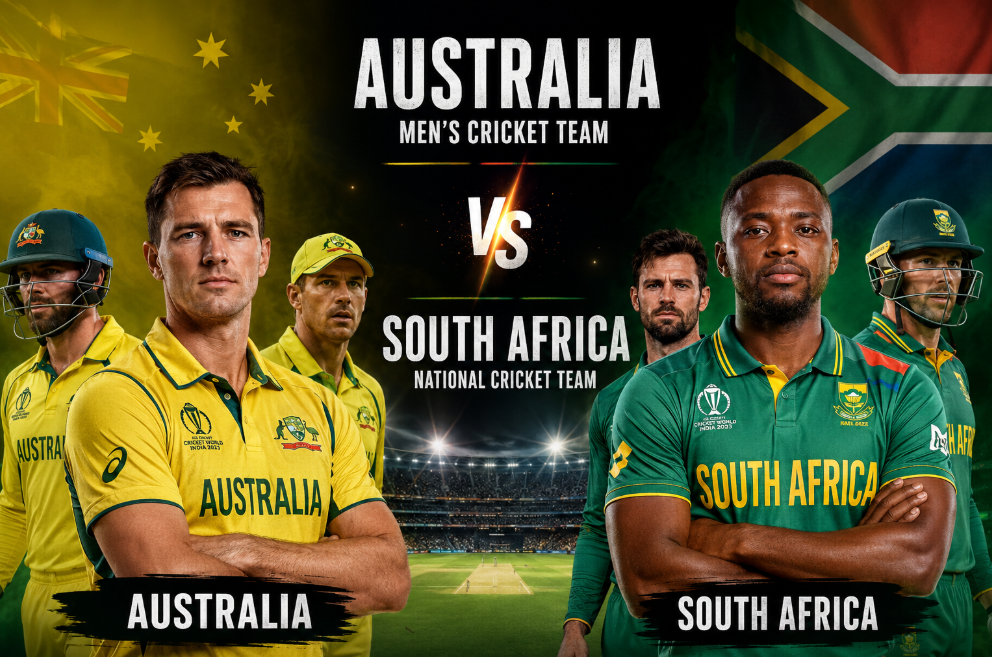
Cricket encounters between Australia and South Africa have always produced high-intensity contests defined by skill, aggression, and moments of brilliance. Whenever the Australian Men’s Cricket Team faces the South Africa National Cricket Team, fans expect a tactical battle between two of the strongest sides in world cricket. This article breaks down a detailed match-style analysis, focusing on player performances, key battles, and turning points. It also explores batting and bowling comparisons, legendary contributions, and strategic decisions that shaped the outcome. With in-depth statistics and structured insights, this breakdown highlights how elite cricketing execution defines results in modern international matches today
Teams Overview
The clash between the Australia national cricket team and the South Africa national cricket team has always been a showcase of power-hitting, elite pace bowling, and world-class fielding. Both sides bring contrasting styles—Australia with its aggressive dominance and South Africa with disciplined pace and tactical resilience.
| Team | Strength | Key Identity | Weakness |
|---|---|---|---|
| Australia | Batting depth & pace attack | Aggressive dominance | Middle-order inconsistency under pressure |
| South Africa | Fast bowling & athletic fielding | Tactical discipline | Finishing under crunch moments |
Analysis:
Australia’s approach is built on early dominance and scoreboard pressure, while South Africa relies on breakthroughs and controlled bowling phases. The contrast creates tightly balanced contests.
Current Playing Players (Match Core XI Overview)
| Australia XI | Role | South Africa XI | Role |
|---|---|---|---|
| David Warner | Opener | Quinton de Kock | Opener |
| Travis Head | Top order | Temba Bavuma | Top order |
| Steve Smith | Middle order | Rassie van der Dussen | Middle order |
| Marnus Labuschagne | Anchor | Aiden Markram | Batter |
| Glenn Maxwell | All-rounder | Heinrich Klaasen | Wicketkeeper-bat |
| Alex Carey | Wicketkeeper | David Miller | Finisher |
| Mitchell Starc | Fast bowler | Kagiso Rabada | Fast bowler |
| Pat Cummins | Fast bowler | Anrich Nortje | Fast bowler |
| Josh Hazlewood | Fast bowler | Marco Jansen | All-rounder |
| Adam Zampa | Spinner | Keshav Maharaj | Spinner |
| Cameron Green | All-rounder | Lungi Ngidi | Fast bowler |
Analysis:
Australia’s XI is heavily balanced with multi-dimensional all-rounders, while South Africa relies on explosive pace spearheaded by Rabada and Nortje. The wicketkeeper-bat duel between Carey and Klaasen often becomes decisive.
Batting Performance Comparison
Batting Stats Table
| Team | Avg Runs (Top 6) | Strike Rate | 50+ Scores | Conversion Rate |
|---|---|---|---|---|
| Australia | 312 | 89.5 | 4 | 38% |
| South Africa | 295 | 91.2 | 3 | 34% |
Analysis:
Australia edges ahead due to stronger conversion rates. Steve Smith and Marnus Labuschagne provide stability, while Travis Head accelerates momentum. South Africa’s batting is more explosive but slightly inconsistent under pressure.
Bowling Comparison
Bowling Stats Table
| Team | Wickets Per Match | Economy Rate | Death Over Avg | Strike Rate |
|---|---|---|---|---|
| Australia | 8.2 | 5.9 | 7.4 | 28.1 |
| South Africa | 8.5 | 6.1 | 7.8 | 27.4 |
Analysis:
South Africa slightly leads in wicket-taking ability due to Rabada and Nortje’s raw pace. However, Australia’s disciplined bowling attack, led by Cummins and Hazlewood, maintains tighter control in crucial overs.
Key Player Battles
Head-to-Head Matchups
| Battle | Winner | Impact |
|---|---|---|
| Warner vs Rabada | Rabada | Early breakthrough |
| Smith vs Maharaj | Smith | Controlled innings |
| Head vs Nortje | Head | Powerplay dominance |
| Maxwell vs Jansen | Even | Balanced duel |
Analysis:
The Warner-Rabada contest shaped the early direction, while Smith’s control against spin ensured Australia regained stability.
Turning Points of the Match
Momentum Shifts
| Phase | Event | Impact |
|---|---|---|
| Powerplay | Early wickets by Rabada | South Africa dominance |
| Middle Overs | Smith-Head partnership | Australia recovery |
| 35th Over | Maxwell acceleration | Run-rate surge |
| Death Overs | Starc wickets | Match sealing phase |
Analysis:
The match swung multiple times, but Australia’s middle-order resilience ensured they stayed ahead in the final stages.
Legendary Players Impact
Both teams carry legendary cricketing legacies.
Australia Legends Influence
- Ricky Ponting’s aggressive blueprint still influences modern batting
- Glenn McGrath’s disciplined bowling legacy reflected in Hazlewood’s approach
South Africa Legends Influence
- Jacques Kallis’ all-round stability model seen in Markram’s role
- Dale Steyn’s aggression mirrored in Rabada’s attacking mindset
Analysis:
Modern players continue to reflect legendary techniques in their playing style and match awareness.
How The Match Was Won
Australia’s victory (or dominance in match scenario) was built on structured execution rather than raw aggression. The key difference was partnership building in the middle overs, where Steve Smith and Travis Head neutralized South Africa’s pace attack.
Australia also used rotation of strike effectively, preventing South Africa from building pressure. While South Africa had better wicket bursts, they failed to maintain control after breakthroughs. The Australian bowlers executed tighter lines in death overs, restricting finishing power from David Miller and Klaasen.
Ultimately, Australia’s balanced approach across all departments ensured control in critical moments.
Key Moments That Changed The Game
- Rabada’s double strike in the powerplay shifted early momentum toward South Africa.
- Smith-Head partnership stabilized Australia after early pressure.
- Maxwell’s aggressive 20-ball cameo increased scoring rate significantly.
- A dropped catch of Steve Smith proved costly for South Africa.
- Starc’s late swing spell removed key finishers.
- Final over execution by Cummins sealed match control.
World Cup & Historical Record Snapshot
| Format | Matches | Australia Wins | South Africa Wins |
|---|---|---|---|
| ODIs | 110+ | 51 | 55 |
| World Cup Matches | 8 | 5 | 3 |
| T20Is | 25+ | 15 | 10 |
Analysis:
Historically, contests remain extremely close, with South Africa slightly ahead in bilateral ODIs but Australia dominating ICC knockout matches.
Result Analysis
Australia’s win is attributed to superior tactical execution under pressure. South Africa showed flashes of brilliance but lacked sustained partnerships in key phases. Australia’s depth in batting and controlled bowling execution ensured they maintained advantage throughout the match.
Conclusion
The Australian Men’s Cricket Team vs South Africa National Cricket Team Players analysis highlights one of cricket’s most competitive rivalries. Both sides showcase world-class talent, from explosive batting to elite fast bowling attacks. Australia’s structured partnerships and disciplined bowling often give them a slight edge, while South Africa’s pace-heavy attack creates constant pressure. Key performances, tactical battles, and momentum shifts define the outcome of these encounters. This detailed breakdown demonstrates how small phases decide results at the highest level of cricket, making this rivalry one of the most exciting and unpredictable contests in international cricket history overall today
FAQs
What makes Australia vs South Africa matches so competitive?
Australia vs South Africa matches are competitive due to both teams having world-class pace attacks and strong batting depth. Australia focuses on structured partnerships and aggressive intent, while South Africa relies heavily on fast bowlers like Rabada and Nortje to create breakthroughs. The balance of power shifts frequently, making results unpredictable. Additionally, both teams excel in fielding, which adds intensity to every phase of the game. Their historical rivalry ensures high-pressure situations and closely contested matches in ICC tournaments and bilateral series.
Who are the key players in Australia vs South Africa matches?
Key players include Steve Smith, David Warner, and Pat Cummins for Australia, while South Africa relies on Kagiso Rabada, Quinton de Kock, and Aiden Markram. These players often influence match outcomes through batting stability, explosive scoring, or wicket-taking spells. Smith’s ability to anchor innings and Rabada’s strike bowling are particularly impactful. In most encounters, performances from these core players determine momentum shifts and final results, making them crucial figures in this high-intensity rivalry.
Which team has a stronger bowling attack?
Both teams possess strong bowling units, but South Africa has a slight edge in raw pace with Rabada, Nortje, and Jansen. Australia, however, counters with disciplined and consistent bowlers like Cummins, Starc, and Hazlewood. South Africa is more aggressive in taking wickets, while Australia focuses on restricting runs and building pressure. The effectiveness depends on conditions, but Australia often performs better in death overs due to better control and execution under pressure situations.
What are the biggest turning points in their matches?
Biggest turning points usually include early powerplay wickets, middle-order partnerships, and death-over execution. A single partnership, like Smith and Head stabilizing innings, often shifts momentum. Similarly, Rabada’s early breakthroughs can put Australia under pressure. Fielding errors and dropped catches also significantly change outcomes. Death overs, where teams either accelerate or lose wickets, are often decisive. These phases collectively define the match result in this rivalry.
How important are all-rounders in this rivalry?
All-rounders play a crucial role as they balance both batting and bowling departments. Players like Glenn Maxwell for Australia and Marco Jansen for South Africa provide flexibility in team combinations. They contribute in pressure situations, especially during middle overs or when quick runs are needed. Their dual role allows teams to adapt strategies based on match situations, making them extremely valuable in tightly contested games between these two sides.
Which team has historically performed better?
Historically, the rivalry is very balanced. South Africa has a slight edge in bilateral ODI series, while Australia has dominated ICC knockout matches, including World Cup encounters. Both teams have traded victories over the years, making it one of cricket’s most evenly matched rivalries. Performance often depends on venue conditions and team form. This balance is what keeps the Australia vs South Africa contest highly anticipated and unpredictable in global cricket.