Table of Contents
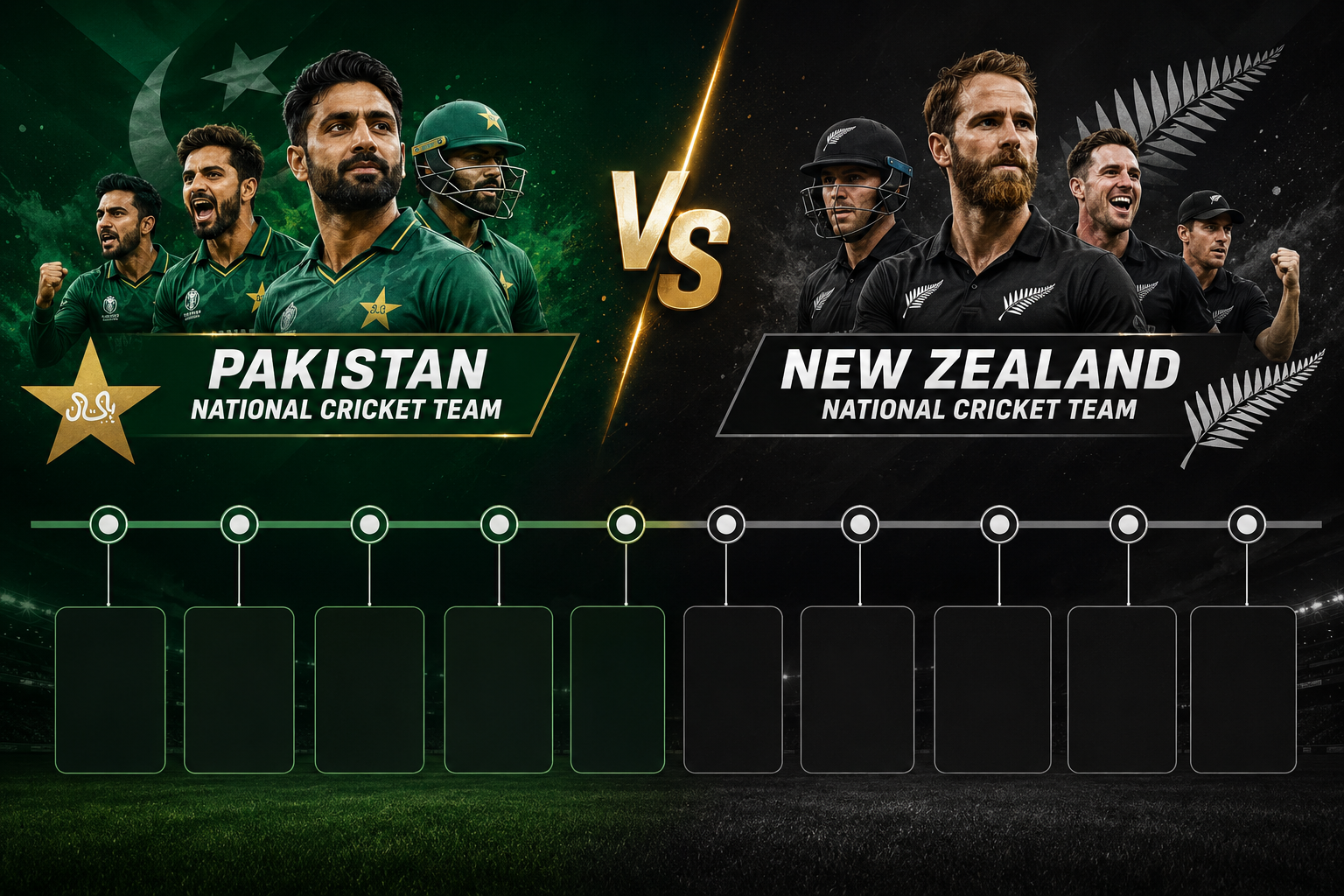
The Pakistan National Cricket Team Vs New Zealand National Cricket Team Timeline is one of international cricket’s most fascinating yet underrated stories. While it may not carry the political intensity of some cricket rivalries, it has consistently produced memorable contests, dramatic World Cup encounters, and career-defining performances. From their first meeting in the 1950s to modern T20 battles, Pakistan and New Zealand have challenged each other across different eras, conditions, and formats. Their rivalry reflects cricket’s evolution itself—moving from timeless Test battles to high-pressure ICC tournaments where every delivery can change history.
How the Rivalry Began: The Early Encounters of the 1950s and 1960s
Pakistan and New Zealand first crossed paths shortly after Pakistan became a Test-playing nation. Both teams were still developing their cricketing identities, making their early contests important milestones rather than blockbuster events.
The first Test series between the sides was played during New Zealand’s tour of Pakistan in 1955. Pakistan was building a reputation for producing world-class bowlers, while New Zealand relied heavily on discipline and patience.
Early Rivalry Milestones
| Year | Event | Result |
|---|---|---|
| 1955 | First Test Match | Pakistan Won |
| 1955 | First Test Series | Pakistan Won 2-0 |
| 1965 | New Zealand Tour of Pakistan | Competitive Drawn Series |
| 1969 | Pakistan Tour of New Zealand | Rivalry Expanded Overseas |
The significance of these matches extends beyond the scorecards. Pakistan used home conditions effectively, while New Zealand gradually learned how to compete in unfamiliar subcontinental environments. These early tours laid the foundation for a rivalry built on adaptability and tactical cricket.
Unlike more emotionally charged rivalries, this one developed through mutual respect. Both teams viewed each other as challenging opponents capable of producing unexpected results.
Building Competitive Balance During the 1970s and 1980s
The 1970s and 1980s transformed the rivalry from occasional contests into a genuinely competitive international matchup.
Pakistan entered a golden era featuring stars such as Imran Khan, Javed Miandad, and Abdul Qadir. New Zealand responded with iconic players including Richard Hadlee and Martin Crowe.
Major Figures of the Era
| Pakistan | New Zealand |
|---|---|
| Imran Khan | Richard Hadlee |
| Javed Miandad | Martin Crowe |
| Abdul Qadir | John Wright |
| Saleem Malik | Jeremy Coney |
The rivalry became particularly intriguing because both teams relied heavily on bowling excellence. Pakistan possessed raw pace and reverse swing, while New Zealand emphasized precision, seam movement, and tactical discipline.
Many matches during this era were decided by individual brilliance. Richard Hadlee often challenged Pakistan’s batting depth, while Imran Khan’s leadership elevated Pakistan in difficult situations.
These decades established the rivalry’s reputation for producing hard-fought cricket rather than one-sided dominance.
The Rise of One-Day Cricket and New Dimensions of Competition
The emergence of One-Day Internationals created new opportunities for both nations to compete on bigger stages.
Pakistan adapted quickly to ODI cricket. Their aggressive batting and versatile bowling attack suited the format perfectly. New Zealand, meanwhile, became pioneers of tactical innovation and strategic field placements.
ODI Growth Through the Decades
| Decade | Key Development |
|---|---|
| 1970s | First ODI meetings |
| 1980s | Regular bilateral ODI series |
| 1990s | Frequent ICC tournament clashes |
| 2000s | Expansion into tri-series competitions |
| 2010s | Increased T20 influence on ODI strategies |
ODI cricket exposed contrasting philosophies. Pakistan often relied on flair and match-winning moments, whereas New Zealand focused on consistency and planning.
This difference in approach created unpredictable contests. No matter which team appeared stronger on paper, results frequently depended on execution under pressure.
Pakistan National Cricket Team Vs New Zealand National Cricket Team Timeline in ICC World Cups
World Cups have delivered some of the most memorable chapters in the Pakistan National Cricket Team Vs New Zealand National Cricket Team Timeline.
Several knockout matches between the teams have become part of cricket folklore.
Famous ICC World Cup Meetings
| Tournament | Stage | Winner |
|---|---|---|
| 1992 World Cup | Semi-Final | Pakistan |
| 1999 World Cup | Group Stage | Pakistan |
| 2011 World Cup | Group Stage | Pakistan |
| 2022 T20 World Cup | Semi-Final | Pakistan |
| 2023 ODI World Cup | League Stage | Pakistan |
The 1992 World Cup semi-final remains one of the rivalry’s defining moments. New Zealand entered as tournament favorites under Martin Crowe’s innovative leadership.
Pakistan, however, staged one of cricket’s greatest comebacks. Inspired by Imran Khan’s “cornered tigers” philosophy, Pakistan defeated New Zealand before going on to win the tournament.
Three decades later, history repeated itself in the 2022 T20 World Cup semi-final. New Zealand arrived as a balanced and disciplined side, but Pakistan delivered an outstanding all-round performance to reach another World Cup final.
These matches elevated the rivalry beyond bilateral cricket and demonstrated its importance on the global stage.
The Test Battles: Skill, Patience, and Tactical Excellence
While modern fans often focus on limited-overs cricket, the Test arena has provided some of the rivalry’s richest cricketing narratives.
Pakistan’s spin-friendly surfaces traditionally tested New Zealand batters, while New Zealand’s green pitches challenged Pakistani batsmen with swing and seam movement.
Test Rivalry Snapshot
| Category | Pakistan | New Zealand |
|---|---|---|
| Traditional Strength | Spin & Reverse Swing | Seam & Swing Bowling |
| Home Advantage | Slow Turning Tracks | Green Seaming Conditions |
| Historic Match Winners | Wasim Akram, Waqar Younis | Hadlee, Southee |
| Key Feature | Aggressive Bowling | Disciplined Cricket |
The contrast in playing environments makes this rivalry unique. Few international rivalries require such drastic adjustments in strategy.
Pakistani teams touring New Zealand often face conditions unlike anything available at home. Similarly, New Zealand teams entering Pakistan must adapt to spin-heavy surfaces and intense local support.
This constant need for adaptation has kept the Test rivalry competitive for decades.
Modern Era: T20 Cricket Changes Everything
The arrival of T20 cricket introduced a completely new dimension.
Pakistan quickly established itself as one of the format’s strongest teams, producing elite fast bowlers and innovative batters. New Zealand embraced analytics, role clarity, and flexible squad construction.
Notable T20 Stars
| Pakistan | New Zealand |
|---|---|
| Babar Azam | Kane Williamson |
| Mohammad Rizwan | Martin Guptill |
| Shaheen Afridi | Trent Boult |
| Haris Rauf | Tim Southee |
One of the defining characteristics of modern contests is tactical depth. Both teams possess bowling attacks capable of defending modest totals and batting lineups capable of chasing difficult targets.
Matches are rarely predictable. Momentum frequently shifts multiple times during a single innings.
This unpredictability has made Pakistan-New Zealand encounters particularly attractive for global audiences.
Individual Records That Defined the Rivalry
Great rivalries are remembered through great performances.
Across decades, numerous players have left lasting marks on Pakistan-New Zealand contests.
Significant Individual Achievements
| Record Type | Player | Achievement |
|---|---|---|
| Test Batting Excellence | Javed Miandad | Multiple Match-Winning Innings |
| Fast Bowling Dominance | Wasim Akram | Historic Wicket Hauls |
| New Zealand Legend | Richard Hadlee | Series-Changing Performances |
| Modern Consistency | Kane Williamson | Runs Across Formats |
| Contemporary Star | Babar Azam | Multiple High-Pressure Innings |
What makes these performances special is their context.
Many occurred in crucial series deciders, ICC tournaments, or difficult overseas conditions. They were not merely statistical achievements but moments that altered outcomes and shaped perceptions of the rivalry.
The best Pakistan-New Zealand players have consistently succeeded because they adapted better than their opponents.
Why New Zealand Often Challenges Pakistan More Than Expected
A recurring theme in the rivalry is New Zealand’s ability to outperform expectations against Pakistan.
On paper, Pakistan has frequently possessed more naturally gifted cricketers. Yet New Zealand has repeatedly found ways to remain competitive.
Factors Behind New Zealand’s Success
| Factor | Impact |
|---|---|
| Tactical Planning | Reduces Pakistan’s unpredictability |
| Fielding Standards | Saves crucial runs |
| Team Stability | Improves consistency |
| Role Clarity | Enhances execution under pressure |
| Adaptability | Effective in foreign conditions |
New Zealand’s cricket culture emphasizes preparation and collective effort. Pakistan’s cricket culture often thrives on individual brilliance and momentum.
Neither approach is inherently superior, which explains why the rivalry remains closely contested.
This strategic contrast adds depth that casual observers sometimes overlook.
Recent Trends and the Future Direction of the Rivalry
The last decade has seen increasingly frequent encounters between the two teams.
ICC tournaments, bilateral series, and tri-nation competitions have ensured regular competition.
Recent Era Highlights
| Period | Major Development |
|---|---|
| 2015–2019 | Rise of Williamson and Babar |
| 2020–2022 | Intense T20 contests |
| 2022 | Pakistan’s T20 World Cup semi-final victory |
| 2023 | Competitive ODI World Cup encounter |
| 2024–2026 | Continued balance across formats |
The rivalry now features a fascinating generational transition.
Pakistan continues producing elite fast bowlers, while New Zealand maintains its reputation for disciplined team cricket.
Future contests are likely to remain highly competitive because both nations possess strong development pathways and a history of performing well in global tournaments.
Rather than declining, the rivalry appears poised for another significant chapter.
What Makes This Rivalry Special in International Cricket
Not every rivalry requires hostility to be meaningful.
Pakistan versus New Zealand stands out because it combines respect, competitiveness, and unpredictability.
The teams represent different cricketing philosophies. Pakistan often embraces instinct and flair. New Zealand prioritizes structure and execution.
Over more than seven decades, neither side has been able to establish permanent dominance. Instead, momentum has shifted repeatedly across generations.
World Cup classics, legendary players, dramatic finishes, and contrasting styles have combined to create a rivalry that consistently rewards cricket fans.
For historians, it represents cricket’s global evolution. For players, it remains a test of adaptability. For supporters, it continues to deliver memorable moments whenever the two nations meet.
Conclusion
The Pakistan National Cricket Team Vs New Zealand National Cricket Team Timeline is a remarkable journey through cricket history. From the first Test meetings in the 1950s to modern T20 World Cup clashes, the rivalry has evolved while retaining its competitive spirit. Historic performances from legends such as Imran Khan, Richard Hadlee, Wasim Akram, Kane Williamson, and Babar Azam have enriched the contest across generations. What makes this rivalry unique is the balance between contrasting cricket cultures, tactical battles, and mutual respect. As both nations continue producing world-class talent, the Pakistan National Cricket Team Vs New Zealand National Cricket Team Timeline remains one of international cricket’s most compelling and enduring stories.
Frequently Asked Questions
When did Pakistan and New Zealand first play against each other in international cricket?
Pakistan and New Zealand first met in Test cricket during New Zealand’s tour of Pakistan in 1955. At that time, Pakistan was still a relatively new Test-playing nation. The series played an important role in establishing relations between the two cricket boards and helped build a rivalry that would grow steadily over the decades. Unlike many modern rivalries that begin through ICC tournaments, this one developed through traditional bilateral cricket and mutual competitive respect.
What is the most famous match in the Pakistan-New Zealand rivalry?
Many cricket historians consider the 1992 World Cup semi-final to be the most significant match between the teams. New Zealand entered the match as tournament favorites after dominating the league stage. Pakistan, however, produced an inspired performance and secured victory before eventually winning the World Cup. The match remains one of the most celebrated moments in Pakistan’s cricket history and one of New Zealand’s most heartbreaking defeats.
Why are Pakistan and New Zealand matches often closely contested?
The rivalry remains competitive because both teams possess different strengths that balance each other. Pakistan traditionally relies on high-quality fast bowling, spin variations, and individual brilliance. New Zealand emphasizes discipline, planning, and team-oriented cricket. These contrasting styles often neutralize each other’s advantages, resulting in unpredictable contests across Tests, ODIs, and T20 Internationals.
Who are the greatest players in this rivalry’s history?
Several legendary cricketers have shaped the rivalry. For Pakistan, Imran Khan, Javed Miandad, Wasim Akram, Waqar Younis, and Babar Azam stand out. For New Zealand, Richard Hadlee, Martin Crowe, Kane Williamson, Trent Boult, and Tim Southee have made major contributions. Their performances have influenced important series, ICC tournaments, and memorable individual contests across multiple generations.
How important have World Cup matches been in this rivalry?
World Cup encounters have significantly enhanced the rivalry’s reputation. Matches in the 1992 ODI World Cup and 2022 T20 World Cup semi-finals are particularly memorable. These high-pressure knockout games attracted global audiences and added historical significance beyond bilateral cricket. Success in ICC tournaments often shapes how rivalries are remembered, and Pakistan-New Zealand has benefited from several iconic World Cup meetings.
Which format has produced the most exciting Pakistan-New Zealand matches?
Each format has contributed differently to the rivalry. Test cricket has showcased technical skill and endurance, while ODIs have produced major World Cup moments. However, T20 Internationals have arguably generated the most dramatic finishes in recent years. The combination of aggressive batting, elite fast bowling, and tactical innovation has made T20 contests between the teams especially entertaining for modern cricket fans.