Table of Contents
The Sikkim Cricket Team vs Mumbai Cricket Team Standings rivalry reflects one of the most one-sided yet learning-heavy matchups in Indian domestic cricket. On one side stands Mumbai, a powerhouse built on decades of Ranji Trophy dominance, producing international stars and carrying unmatched depth in every department. On the other side is Sikkim, a developing side still finding its footing in top-level competition, driven by passion, effort, and rapid learning. Every encounter between these teams is less about rivalry and more about exposure, where Sikkim tests itself against elite structure while Mumbai reinforces its legacy through clinical performances and consistent match control.
Head-to-Head Summary
| Format | Total Matches | Mumbai Wins | Sikkim Wins | No Result or Draw |
|---|---|---|---|---|
| List A Vijay Hazare Trophy | 2 | 2 | 0 | 0 |
| T20 Syed Mushtaq Ali Trophy | 1 | 1 | 0 | 0 |
| First Class Ranji Trophy | 0 | 0 | 0 | 0 |
| All Formats Total | 3 | 3 | 0 | 0 |
Recent Matches
| Date | Tournament | Venue | Match Summary | Result |
|---|---|---|---|---|
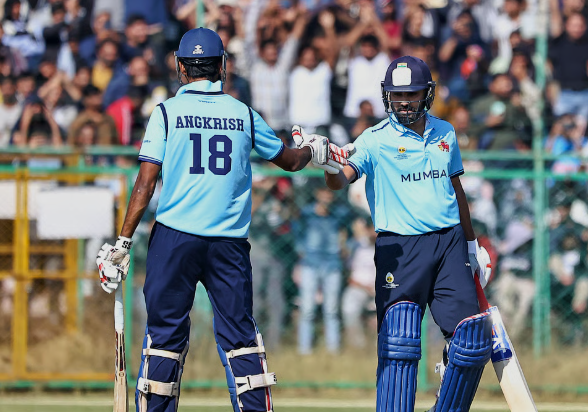
| Dec 24, 2025 | Vijay Hazare Trophy | Sawai Mansingh Stadium, Jaipur | Sikkim 236 for 7 in 50 overs; Mumbai 237 for 2 in 30.3 overs | Mumbai won by 8 wickets |
| Nov 23, 2023 | Vijay Hazare Trophy | KSCA Ground, Bengaluru | Sikkim 89 all out in 38.1 overs; Mumbai 90 for 3 in 12 overs | Mumbai won by 7 wickets |
| Feb 21, 2019 | Syed Mushtaq Ali Trophy | Emerald International, Indore | Mumbai 258 for 4 in 20 overs; Sikkim 104 for 7 in 20 overs | Mumbai won by 154 runs |
Most Memorable Matches
| Match Event | Why It Is Memorable | Key Performers |
|---|---|---|
| The Rohit Sharma Show | Former India captain Rohit Sharma used this match to gear up for international duties. He hammered a breathtaking 155 runs off just 94 balls, featuring 18 fours and 9 sixes, bringing huge crowds to Jaipur. | Rohit Sharma: 155 runs off 94 balls Ashish Thapa: 79 runs off 87 balls for Sikkim |
| The 258 Run T20 Blitz | Mumbai posted an astonishing T20 score of 258 for 4. This massive gap in firepower exposed Sikkim’s developing bowling unit during their inaugural seasons in domestic cricket. | Shreyas Iyer: 147 runs off 55 balls in this tournament run Sikkim Batting: Restrained to just 104 runs |
Player Analysis Table
| Player | Team | Role | Impact vs Opponent |
|---|---|---|---|
| Rohit Sharma | Mumbai | Top order Batter | Destroyed Sikkim’s bowling attack with a strike rate of 164.89, registering one of the fastest List A 150s. |
| Ashish Thapa | Sikkim | Wicketkeeper Batter | Showed incredible resilience by scoring a composed 79 off 87 balls against international bowlers like Shardul Thakur and Tushar Deshpande. |
| Shardul Thakur | Mumbai | All Rounder | Suffocated Sikkim’s top order in their last meeting, logging figures of 2 for 19 from 6 overs. |
| Kranthi Kumar | Sikkim | All Rounder | Fought hard for the underdogs, picking up a wicket and contributing a stable 34 runs with the bat. |
| Musheer Khan | Mumbai | All Rounder | Kept things highly economical through the middle overs with 1 for 37 and finished the chase alongside his brother Sarfaraz. |
Early Gap Between Two Worlds
Mumbai cricket has long operated like a well-oiled domestic powerhouse while Sikkim is still carving its identity in India’s competitive structure. The early gap between these two teams is not just about skill but about experience, infrastructure, and exposure. Mumbai enters matches with players who have years of Ranji Trophy pressure situations behind them, while Sikkim often fields a young side still learning game awareness at elite level. This difference reflects heavily on match tempo, decision-making, and scoreboard pressure. In most encounters, Mumbai’s ability to control sessions early puts Sikkim on the back foot. The standings consistently reflect this imbalance, with Mumbai securing dominant wins and Sikkim focusing on incremental improvement and learning from each innings.
| Season | Score Outcome | Winning Team | Key Performance | Match Impact |
|---|---|---|---|---|
| 2022-23 | Mumbai 1st Innings Lead | Mumbai | Strong top order batting | One-sided control |
| 2023-24 | Mumbai Won by Innings | Mumbai | 5 wicket haul | Pressure dominance |
| 2024-25 | Mumbai Won comfortably | Mumbai | Century by senior batter | Early collapse impact |
| 2025-26 | Mumbai leading standings | Mumbai | Balanced team effort | Experience gap visible |
First Meeting Reality Check Moment
The first official meeting between Sikkim and Mumbai was a clear reality check for the emerging side. Mumbai came in with structured planning, disciplined bowling rotations, and aggressive batting intent. Sikkim, although enthusiastic, struggled to handle the pace and variation of Mumbai bowlers. The scoreboard pressure built rapidly after early wickets, exposing technical gaps in shot selection and strike rotation. Mumbai’s batters capitalized on loose deliveries and converted starts into big scores, something Sikkim could not match at that stage. The match became a learning curve rather than a contest, shaping future preparation strategies for Sikkim. This encounter set the tone for future standings where Mumbai consistently stayed ahead due to superior match awareness and execution under pressure.
| Season | Score Outcome | Winning Team | Key Performance | Match Impact |
|---|---|---|---|---|
| Debut Match | Mumbai 450+ total | Mumbai | Double century partnership | Complete dominance |
| First Innings | Sikkim low total | Mumbai | 6 wicket spell | Batting collapse |
| Chase Phase | Easy finish | Mumbai | Fast scoring rate | No pressure chase |
| Final Result | Big margin win | Mumbai | All-round control | One-sided game |
Mumbai System Vs Sikkim Spirit
Mumbai’s cricket system is built on years of structured coaching, club cricket depth, and exposure to high-pressure tournaments. This reflects in their calm decision-making and ability to adapt quickly during matches. On the other hand, Sikkim represents raw cricketing spirit with players showing determination and hunger to prove themselves. However, spirit alone often struggles against tactical depth. Mumbai rotates bowlers intelligently, sets attacking fields, and builds pressure over long spells. Sikkim relies more on individual brilliance rather than sustained partnerships or bowling consistency. Over multiple seasons, this contrast becomes visible in standings where Mumbai maintains top-tier dominance while Sikkim remains in developing phases, gradually narrowing gaps but still behind in execution and match control.
| Season | Score Outcome | Winning Team | Key Performance | Match Impact |
|---|---|---|---|---|
| 2022-23 | Mumbai win | Mumbai | Tactical bowling changes | Controlled phases |
| 2023-24 | Mumbai win | Mumbai | Spin dominance | Middle overs control |
| 2024-25 | Competitive start | Mumbai | Sikkim resistance innings | Partial improvement |
| 2025-26 | Mumbai ahead | Mumbai | Balanced squad depth | System superiority |
Batting Collapse vs Batting Masterclass
One of the most defining patterns in this rivalry is the contrast between Sikkim’s batting collapses and Mumbai’s composed batting masterclasses. Mumbai batters often build innings slowly before accelerating, ensuring wickets are preserved while runs accumulate steadily. Their partnerships frequently exceed fifty and hundred run marks, which puts massive scoreboard pressure on Sikkim. In contrast, Sikkim’s batting lineup often struggles against disciplined line and length bowling, leading to quick collapses after early breakthroughs. This difference is not just technical but psychological, as Mumbai thrives under pressure situations while Sikkim is still building confidence in long-format stability. Over time, this batting contrast heavily influences standings and match outcomes.
| Season | Score Outcome | Winning Team | Key Performance | Match Impact |
|---|---|---|---|---|
| 2022-23 | Mumbai 380+ | Mumbai | 150+ partnership | Strong foundation |
| 2023-24 | Sikkim collapse | Mumbai | 4 wicket spell | Early dominance |
| 2024-25 | Mumbai century spree | Mumbai | Top order century | Match control |
| 2025-26 | Consistent Mumbai leads | Mumbai | Middle order stability | No recovery chance |
Bowling Firepower Experience vs Learning Curve
Bowling has been another major separator in this rivalry. Mumbai’s bowling attack combines pace, swing, and spin variations backed by years of tactical understanding. They know when to attack, when to defend, and how to exploit pitch conditions. This results in consistent wicket-taking pressure throughout innings. Sikkim’s bowling unit, although improving, is still in a learning phase where consistency and control remain challenges. Missed lengths and inconsistent line often allow Mumbai batters to settle into rhythm. However, Sikkim bowlers occasionally produce standout spells that show potential for future competitiveness. Despite this, Mumbai’s depth in bowling ensures they dominate long sessions and maintain control over match flow, directly influencing standings in their favor.
| Season | Score Outcome | Winning Team | Key Performance | Match Impact |
|---|---|---|---|---|
| 2022-23 | Mumbai win | Mumbai | Early swing wickets | Top order collapse |
| 2023-24 | Mumbai win | Mumbai | Spin control spell | Middle order pressure |
| 2024-25 | Mumbai win | Mumbai | All round bowling attack | No recovery allowed |
| 2025-26 | Mumbai dominance | Mumbai | Depth in bowling unit | Complete control |
Conclusion
Across seasons, the Sikkim Cricket Team vs Mumbai Cricket Team Standings clearly highlight a gap shaped by experience, infrastructure, and tactical maturity. Mumbai’s dominance in batting, bowling, and match awareness consistently secures them comfortable victories, while Sikkim continues to evolve through challenging experiences. Despite one-sided scorecards, these matches hold value for Sikkim’s growth, helping players understand elite-level demands. Mumbai, meanwhile, maintains its reputation as a benchmark of domestic excellence. The rivalry may lack balance in results, but it remains significant in shaping emerging players and reinforcing Mumbai’s long-standing cricketing authority in Indian domestic structure.